



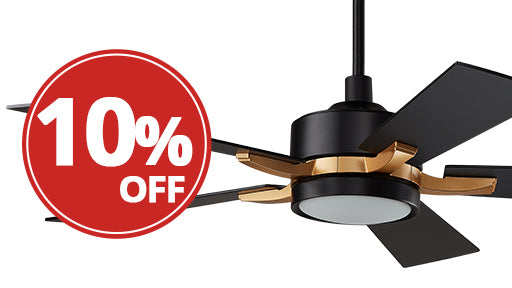









Yes, you can hang a ceiling fan on a vaulted or sloped ceiling. Three things have to line up: the fan's mount must be rated for your ceiling angle, the downrod must be long enough for the blades to clear the slope, and the blades should end up 8 to 9 feet above the floor. Most of our ceiling fans for vaulted ceilings list a 27° maximum slope and ship with an angled mount, so most vaulted rooms don't need a separate slope adapter.
This guide takes you through the decisions in the order you'll make them. Measure the angle, confirm the mount rating, size the downrod, place the fan, and then pick a fan big enough for the extra air a tall room holds.
Vaulted, Cathedral or Sloped: Same Fan, Different Checks
The three names describe different ceiling shapes, but the fan you need is the same: a downrod fan with an angled mount. What changes is where you measure and which way the blades need clearance.
| Ceiling type | Shape | What to check |
|---|---|---|
| Sloped (shed or single slope) | One flat plane rising from a low wall to a high wall | Clearance on the downhill side, and distance to the low wall |
| Cathedral | Two equal slopes meeting at a center ridge, following the roofline | Clearance on both sides; the box at the ridge must be fan-rated and braced |
| Vaulted | Any ceiling raised above the standard 8 to 9 feet, often sloped or arched | Ceiling height at the mounting point, which sets the downrod length |
If your vaulted ceiling is flat but tall, skip the slope steps and go straight to the downrod table in Step 3.
Step 1: Measure Your Ceiling Slope
Everything else depends on this number, so measure it before you shop. There are two easy ways to do it.
The level method. Hold a 2-foot level horizontally so one end touches the ceiling, and center the bubble. Mark 12 inches along the level from the touch point. Then measure straight up from that mark to the ceiling. That measurement is your "rise per 12 inches." A 6-inch rise means a 6/12 pitch.
The phone method. Open a free angle or level app. Hold the phone flat against the ceiling surface, or against a hardcover book pressed to the ceiling for a steadier read. The app shows the angle in degrees directly.
If your ceiling follows the roofline, as most cathedral ceilings do, the ceiling pitch is the same as the roof pitch on your house plans.

Use this table to convert pitch to degrees and see whether a 27° mount covers it:
| Ceiling pitch | Angle | Covered by a 27° mount? |
|---|---|---|
| 3/12 | 14.0° | Yes |
| 4/12 | 18.4° | Yes |
| 5/12 | 22.6° | Yes |
| 6/12 | 26.6° | Yes, close to the limit |
| 7/12 | 30.3° | No |
| 8/12 | 33.7° | No |
In short, 6/12 is the steepest standard pitch a 27° mount handles.
Step 2: Check the Fan's Slope Rating
A sloped-ceiling fan hangs from a ball joint at the top of the downrod. The ball sits in a hanger bracket, so the fan hangs straight down while the canopy tilts to match the ceiling. The slope rating tells you how far the ceiling can tilt before the canopy edge hits the downrod. Past that point, the fan can't hang plumb and it will wobble.

Check the spec sheet before you buy. Look for the "Mounting Type" and "Ceiling Type" lines. For example, the Yarmouth 52-inch fan lists "Downrod max slope of 27 degrees," a ceiling type of "Flat, Sloped," and a 4.5-inch downrod in the box.
Some spec sheets give the limit as 25° to 27° and add that a longer downrod is needed at the steep end. Treat 25° as the comfortable limit with the stock rod, and plan on an extension near 27°. Step 3 shows how long it needs to be.
If your ceiling is steeper than 27°, don't force a standard mount. The canopy will bind against the downrod, and the fan will never run smoothly. Choose a fan whose maker rates it for your exact angle, or have an electrician confirm the mounting options before you buy.
Do You Need a Sloped Ceiling Fan Adapter?
Only if the fan's own mount can't handle your angle. A sloped ceiling adapter is an extra bracket that adds tilt to a mount that has little or none. It's mostly sold for fans with a fixed canopy or a very low slope rating.
If the spec sheet already lists "Angled Mount" and a maximum slope at or above your pitch, the ball-joint hanger in the box does that job, and an adapter adds nothing but another joint to loosen. If your pitch is above the rating, an adapter from a different brand isn't a safe fix either, because it changes how the fan's weight sits on the bracket. Pick a fan rated for the angle instead.
Step 3: Pick the Downrod Length (Two Checks)
A sloped ceiling needs two checks, not one. The first sets the height of the blades above the floor. The second makes sure the blades clear the slope itself.
Check 1: Blade height above the floor
Measure the ceiling height at the spot where the fan will hang, which is usually the electrical box. Do not measure at the peak or at the low wall. On a sloped ceiling those numbers can differ by several feet, and the mounting point is the only one that matters.
| Ceiling height at the mounting point | Downrod length |
|---|---|
| 8 to 9 ft | Downrod included with the fan |
| 10 ft | 14 in |
| 10.5 ft | 18 in |
| 11 ft | 24 in |
| 12 ft | 36 in |
| 13 ft | 46 in |
| 14 ft | 54 in |
| 15 ft | 62 in |
| 16 ft | 70 in |
These lengths match the extension chart on our downrod fans' spec sheets. Every length is sold in our ceiling fan downrods range for DC-motor fans. Downrods for AC-motor fans stop at 46 inches.

Need the diameter, threading, or the flat-ceiling formula? Our downrod sizing guide covers those. This guide adds the one check a flat ceiling never needs.
Check 2: Blade clearance from the slope
On a flat ceiling, the gap between the blades and the ceiling is the same all the way around. On a slope it isn't. The ceiling drops toward the blade tips on the downhill side, and it drops more with a bigger fan and a steeper pitch. The math is simple: blade radius × rise ÷ 12.
Then add the standard 8-inch minimum gap between the blades and the ceiling. The table below gives the minimum vertical space you need between the ceiling at the mounting point and the blades:
| Fan size | 3/12 pitch | 4/12 pitch | 5/12 pitch | 6/12 pitch |
|---|---|---|---|---|
| 44 in | 14 in | 16 in | 18 in | 19 in |
| 52 in | 15 in | 17 in | 19 in | 21 in |
| 56 in | 15 in | 18 in | 20 in | 22 in |
| 60 in | 16 in | 18 in | 21 in | 23 in |
| 65 in | 17 in | 19 in | 22 in | 25 in |

Compare that number with the "ceiling to blade" dimension on the fan's spec sheet, measured with the downrod you plan to use. If the spec is shorter, step up to the next downrod length.
Worked example: You're hanging a 52-inch fan on a 6/12 slope, and the mounting point is 9 feet high. Check 1 says the included downrod is enough. Check 2 says you need about 21 inches between the ceiling and the blades. If the fan measures less than that with its stock rod, use a 14-inch extension. With 21 inches of drop, the blades still sit about 7 ft 3 in above the floor, which clears the 7-foot safety minimum.
Step 4: Where to Mount a Fan on a Vaulted Ceiling
Keep the blades at least 7 feet above the floor, and aim for 8 to 9 feet. Keep the blade tips at least 18 inches from any wall, measured horizontally. On a sloped ceiling, also measure to the low wall, not just the side walls. Our ceiling fan clearance guide lists every distance for floors, walls, vents, and multiple fans.
Center the fan over the usable floor area, such as the seating group or the bed, not the center of the ceiling surface. On a single-slope ceiling, the center of the ceiling surface usually sits closer to the low wall than to the middle of the room. Mounting there means shorter blade-to-wall clearance and a lower hanging height.
On a cathedral ceiling, the ridge is usually the natural spot because it sits over the middle of the room. The box there must be listed for fan support and braced between the framing. If you're reusing a light's box, Can You Replace a Light Fixture With a Ceiling Fan? walks through how to check it.
Watch for beams and skylights near the fan too. Leave at least 2 feet between the blade tips and anything they could sweep past.

Step 5: Size the Fan for a Tall Room
Start with floor area. Our room size chart matches fan diameter to square footage.
A vaulted ceiling changes one thing: a room with the same floor area holds more air than a flat-ceiling room. Two adjustments help:
- Lean toward the top of the size range. If the chart puts your room right between two sizes, go with the larger one.
- Compare CFM, not only diameter. Two fans of the same size can move very different amounts of air. Our guide to ceiling fan airflow explains how to read the number.
Our large ceiling fans cover most vaulted living rooms and bedrooms.
For open-plan spaces and great rooms, step up to our 56- and 60-inch great room fans. If airflow matters most, compare models in our high CFM ceiling fans lineup.
Controls and Winter Mode on a High Ceiling
A fan hanging 3 feet below a 12-foot peak is out of reach, so a pull chain is no help. Choose a fan with a remote, a wall control, or both. Ceiling Fan Remote vs Wall Switch: Which Is Better? compares the two.
Tall rooms also trap warm air under the peak in winter. Running the fan in reverse at a low speed pushes that air down the walls without a noticeable draft. Our guide to ceiling fan direction in winter and summer shows which way to set it.
Fans That Suit Vaulted Ceilings
Each fan below lists a 27° maximum slope, a "Flat, Sloped" ceiling type and a 4.5-inch downrod in the box on its spec sheet. Each one has a DC motor and a remote, so it takes the full range of extension downrods.
| Fan | Size and room | Airflow | Light |
|---|---|---|---|
| Yarmouth 52 inch | 52 in, rooms of 145 to 300 sq ft | 5,110 CFM | No light |
| Thora 60 inch | 60 in, great rooms over 300 sq ft | 6,410 CFM | No light |
| Essex Pro 60 inch | 60 in, great rooms over 300 sq ft; damp-rated for covered porches | 5,400 CFM | Dimmable LED, 1,500 lumens |
For more styles, browse the full range of downrod ceiling fans rated for sloped ceilings and check the "Mounting Type" line on each one.


Common Sloped-Ceiling Mistakes
- Buying a flush-mount fan. Hugger fans are built to sit tight against a flat surface. On a slope the canopy can't seat properly, and the blades end up far too close to the ceiling. Our spec sheets say it plainly: low-profile fans are not suitable for angled or vaulted ceilings.
- Measuring height at the peak. Size the downrod from the ceiling height at the mounting point. Using the peak height gives you a rod that's far too long.
- Keeping the short stock downrod on a steep slope. It may pass the floor-height check and still fail the slope-clearance check. Run both checks.
- Reusing a light-fixture box. A ceiling fan must hang from an electrical box listed for fan support. A standard light box isn't built for a fan's weight and motion.
- Skipping the angle check. A fan rated for flat ceilings, or for less than your pitch, will wobble no matter how carefully you balance it.
Frequently Asked Questions
Can you put a ceiling fan on a sloped ceiling?
Yes. Use a downrod fan with an angled mount rated for your ceiling pitch, pick a downrod long enough for the blades to clear the slope, and hang the blades 8 to 9 feet above the floor.
What is the maximum ceiling angle for a ceiling fan?
It depends on the fan's mount. Most Smafan downrod fans list a maximum slope of 27°, which covers pitches up to 6/12. Steeper ceilings need a fan that its maker rates for that specific angle.
Do I need a sloped ceiling adapter for a Smafan fan?
Not if the spec sheet lists an angled mount with a maximum slope at or above your pitch. The hanger in the box handles the angle. Near the top of the rating, plan on a longer downrod.
How high should a ceiling fan hang on a vaulted ceiling?
Aim for blades 8 to 9 feet above the floor, and never lower than 7 feet. Measure the ceiling height at the mounting point and use the downrod table in Step 3 to get there.
Can a flush-mount ceiling fan go on a vaulted ceiling?
Generally, no. Flush-mount fans attach directly to the ceiling with no downrod, so they have nothing to correct for the angle. On a slope, choose a downrod fan instead.
What size downrod do I need for a 12-foot vaulted ceiling?
If the ceiling is 12 feet high at the mounting point, start with a 36-inch downrod. Then check the slope-clearance table in Step 3, especially for fans 56 inches and larger on steeper pitches.
Where should I mount a fan on a cathedral ceiling?
Usually at the ridge, over the middle of the room. A cathedral ceiling slopes down on both sides, so the blades need clearance on two sides instead of one. Use the pitch of either side in the clearance table, and make sure the box at the ridge is fan-rated and braced between the framing.
Get the Angle Right First
Measure the pitch, confirm the fan's slope rating, then size the downrod with both checks. Do those three things, and a vaulted ceiling becomes one of the best places in the house for a fan. It can push warm air down from the peak in winter and move a lot of air in summer.
When you're ready, start with our vaulted ceiling fans and check the "Mounting Type" line for your angle.


